Personal Loan for Medical Emergency: Instant Approval, Interest Rates & Documents (2026)

Introduction
A medical emergency never waits for the right moment. A sudden hospitalisation, an accident, or an unexpected surgery can leave a family facing a bill of Rs. 2 lakh, Rs. 5 lakh or more within hours — and health insurance, if you have it, may not cover everything, or the claim may take days to settle. In such moments, a personal loan for a medical emergency can be the fastest way to arrange funds. Most banks and NBFCs in India now approve these loans within a few hours, and some fintech lenders disburse the money in under 30 minutes. This guide explains how a personal loan for a medical emergency works, what interest rates to expect in 2026, who can apply, which documents you need, and how to get the money quickly without falling into a debt trap.
Key Takeaways
- A personal loan for a medical emergency is an unsecured loan you can use for hospital bills, surgery, medicines, or any treatment cost, with no collateral and no restriction on how the money is spent.
- Most lenders approve and disburse these loans within a few hours to 24 hours; pre-approved customers of major banks can get the money in minutes.
- Interest rates in 2026 typically range from 10.5% to 24% per annum, depending on your credit score, income, and lender.
- You can usually borrow Rs. 50,000 to Rs. 25 lakh, with repayment tenures from 12 months to 60 months.
- A CIBIL score of 750 or above gets you the lowest rates and fastest approval; a score below 650 will mean higher rates or a rejection.
- Compare at least three lenders before applying, because the same borrower can be offered rates that differ by 4 to 5 percentage points.
- Always check the processing fee, prepayment charges, and late-payment penalty before signing, not just the headline interest rate.
What Is a Personal Loan for a Medical Emergency?
A personal loan for a medical emergency is simply a regular personal loan taken to pay for urgent medical treatment. Unlike a health insurance claim, there is no waiting for approvals from an insurer, no list of covered hospitals, and no paperwork proving that the treatment was necessary. The lender gives you a lump sum in your bank account, and you can spend it on anything related to the emergency — hospital admission deposits, surgery, ICU charges, medicines, diagnostic tests, ambulance charges, or even follow-up treatment at home.
Because the loan is unsecured, you do not need to pledge property, gold, or fixed deposits. The lender decides based on your income, your credit score, and your repayment history. Most lenders now offer a fully digital process: you apply on the bank’s app or website, upload your documents, complete video KYC, and the money reaches your account the same day. Some banks also offer a special “medical loan” or “healthcare loan” product, but in practice these are personal loans with the same features and a medical purpose, so there is no need to search only for a product with that exact name.
Personal Loan vs Other Ways to Pay a Medical Bill
When a hospital bill arrives suddenly, most families have a few options. The table below compares them honestly, so you can pick the cheapest and fastest route available to you.
| Option | Speed of funds | Typical cost | Main drawback |
|---|---|---|---|
| Personal loan | A few hours to 24 hours | 10.5%–24% per annum | Interest cost if tenure is long |
| Health insurance claim | Cashless in hours, reimbursement in days | Premium already paid | May not cover full bill; exclusions apply |
| Credit card | Instant | 36%–42% per annum if unpaid | Very expensive if not repaid in 45 days |
| Gold loan | Same day | 9%–14% per annum | Needs gold as collateral |
| Loan against FD | Same day | FD rate + 1%–2% | Needs an existing fixed deposit |
| Borrowing from family | Depends on them | Usually nil | Not always available; strains relationships |
The practical rule is simple: use health insurance first, because that money costs you nothing extra. Use your savings or a loan against FD next, because they are the cheapest. A personal loan is the right choice when insurance falls short and you have no liquid savings or gold to pledge — it is far cheaper than leaving a credit card balance unpaid, and far faster than selling investments in a hurry.
Personal Loan Interest Rates for Medical Emergencies in 2026
Interest rates on personal loans in India depend mainly on your credit score and the lender. The indicative ranges below are based on publicly advertised rates in 2026; the exact rate you are offered depends on your profile.
| Lender type | Indicative interest rate | Processing fee | Typical disbursal time |
|---|---|---|---|
| Large private banks (HDFC, ICICI, Axis, Kotak) | 10.50%–18% per annum | Up to 2.5% of loan amount | 24 hours; minutes for pre-approved customers |
| Public sector banks (SBI, PNB, Bank of Baroda) | 10.75%–15% per annum | Up to 1.5% of loan amount | 1–3 working days |
| NBFCs (Bajaj Finserv, Tata Capital, Piramal) | 12%–22% per annum | Up to 3% of loan amount | Same day in most cases |
| Fintech and app-based lenders | 14%–28% per annum | Up to 3% of loan amount | Minutes to a few hours |
On a loan of Rs. 3 lakh at 12% interest for 3 years, your EMI is about Rs. 9,964 and the total interest paid is about Rs. 58,700. At 18% for the same amount and tenure, the EMI rises to about Rs. 10,845 and total interest to about Rs. 90,400. That difference of more than Rs. 31,000 is why comparing lenders matters, even in an emergency.
Who Can Apply: Eligibility Criteria
Most lenders use similar eligibility rules for a personal loan, whether the purpose is medical or anything else. You should meet the following conditions:
- Age: 21 to 60 years at the time of application (up to 65 at loan maturity for some lenders).
- Employment: Salaried with at least 1 to 2 years of work experience, or self-employed with at least 2 to 3 years of business history and filed income tax returns.
- Minimum income: Usually Rs. 20,000 to Rs. 25,000 per month for salaried applicants in metro cities; some lenders accept Rs. 15,000 per month.
- Credit score: A CIBIL score of 750 or above is ideal. Scores between 700 and 749 usually get approved at higher rates, while scores below 650 face frequent rejections.
- Existing obligations: Your total EMIs, including the new loan, should generally not exceed 40% to 50% of your monthly income.
- Bank account: A salary account or a savings account with regular credits, usually with the same bank or an account you have operated for at least 6 months.
If your credit score is low or you have no credit history, a few options still exist: apply with a co-applicant who has a good score, take a smaller loan amount, or approach the bank where your salary account is held, since it can see your income history directly. If the emergency is immediate and no lender approves you, a gold loan or a loan against your fixed deposit is usually the fastest fallback, because these are secured and do not depend on your credit score.
Documents Required for a Medical Emergency Personal Loan
| Document | Salaried applicants | Self-employed applicants |
|---|---|---|
| Identity proof | PAN card, Aadhaar card, passport or voter ID | Same as salaried |
| Address proof | Aadhaar, passport, utility bill or rent agreement | Same as salaried |
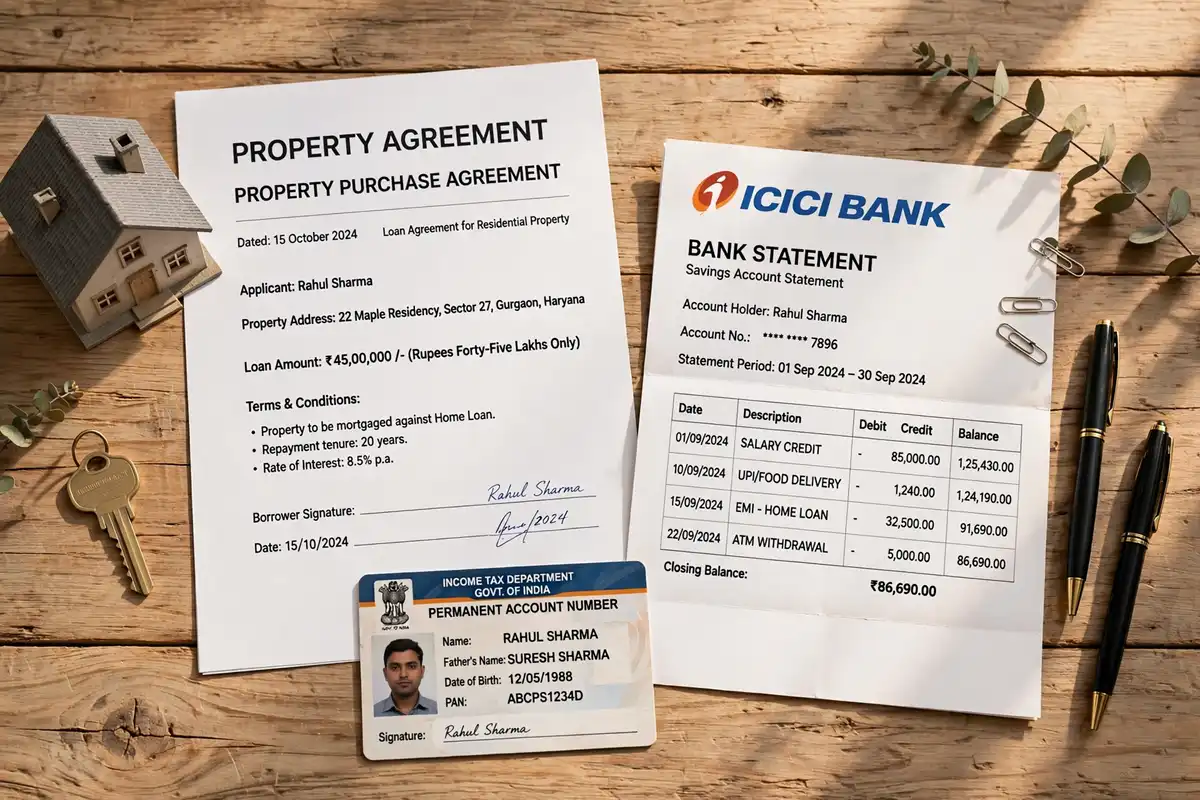
| Income proof | Salary slips for last 3 months, Form 16 | ITR for last 2–3 years, audited financials |
| Bank statements | Last 6 months | Last 6–12 months |
| Employment proof | Employment certificate or appointment letter | Business registration, GST certificate |
| Medical papers (optional) | Hospital estimate or admission letter | Hospital estimate or admission letter |
Medical papers are not compulsory for a personal loan, because the lender does not restrict how you use the money. But attaching a hospital estimate or admission letter can help in two ways: some lenders prioritise medical-purpose applications, and if you are negotiating a lower rate or a higher amount, proof of a genuine emergency strengthens your case.
How to Apply for a Medical Emergency Personal Loan in 6 Steps
1. Check your credit score first
Check your CIBIL score free on the bureau’s website or through your bank’s app before applying. If it is 750 or above, you are in a strong position. If it is lower, avoid applying to five lenders at once, because every application creates a hard enquiry that can pull your score down further.
2. Compare lenders in one place
Use your bank’s app and one or two loan comparison websites to see the interest rate, processing fee, and disbursal time for your profile. Prefer your existing bank first — pre-approved offers there are usually the fastest and cheapest.
3. Keep documents ready as soft copies
Save clear scans of your PAN, Aadhaar, salary slips, and bank statements on your phone. In an emergency, the minutes you save here decide whether the money arrives tonight or tomorrow.
4. Apply online and complete video KYC
Fill the application on the lender’s website or app and complete video KYC when prompted. Keep your PAN card in hand during the call and answer from a quiet place with good light, since a failed KYC is a common reason for delays.
5. Accept the sanction and check the details
Before accepting, read the sanction letter: the exact interest rate, processing fee, EMI, tenure, prepayment charges, and late-payment fee. If any number differs from what was promised, ask the lender to correct it before you accept.
6. Receive the money and pay the hospital
Once you accept, the money is credited to your bank account, usually within hours. Pay the hospital directly and keep every receipt, since you may need them for an insurance claim or a tax record later.
How Much Can You Borrow? EMI Examples
| Loan amount | Interest rate | Tenure | Monthly EMI | Total interest |
|---|---|---|---|---|
| Rs. 1 lakh | 12% | 2 years | Rs. 4,707 | Rs. 12,968 |
| Rs. 3 lakh | 12% | 3 years | Rs. 9,964 | Rs. 58,704 |
| Rs. 5 lakh | 13% | 4 years | Rs. 13,440 | Rs. 1,45,120 |
| Rs. 10 lakh | 14% | 5 years | Rs. 23,268 | Rs. 3,96,080 |
Borrow only what the hospital actually needs, not the maximum the lender offers. A shorter tenure costs more every month but saves a large amount of interest overall. If your cash flow is uncertain, pick a longer tenure and prepay the loan in parts whenever you have extra money — but check first that your lender allows part-prepayment without charges, because some lenders charge 2% to 4% on prepayment during the first year.
Tips to Get Instant Approval in an Emergency
- Use your own bank first. Pre-approved personal loans from the bank that holds your salary account are the fastest option, often disbursed in minutes with no documents.
- Keep your credit score healthy. Pay credit card bills and EMIs on time every month, because a single missed payment can stay on your credit report for years.
- Borrow within your means. Asking for Rs. 2 lakh when your income supports Rs. 5 lakh gets approved faster than asking for the maximum.
- Apply during working hours. Applications made late at night are often processed the next morning, so apply as early in the day as possible.
- Keep your phone reachable. Lenders call to verify your employment and address; a missed verification call can delay disbursal by a full day.
- Avoid multiple applications. Apply to one lender, wait for the decision, and only then try another. Five applications in one week can reduce your credit score.
Mistakes to Avoid When Taking a Medical Loan
The biggest mistake is borrowing more than the hospital bill requires, because every extra rupee costs interest for years. The second is choosing the longest tenure to get a low EMI without noticing the total interest, which can be 40% to 50% of the amount borrowed. The third is ignoring the processing fee and other charges: a loan at 11% with a 3% processing fee can cost more than a loan at 12% with no fee. Also beware of agents who promise a loan without any credit check or documents — genuine lenders always check your credit history, and anyone who asks for an advance fee before disbursal is running a scam. Finally, never take a medical loan on a credit card’s “easy EMI” offer without checking the interest rate, because some of these carry rates above 20% with hidden charges.
Frequently Asked Questions
Can I get a personal loan for a medical emergency the same day?
Yes, in most cases. Pre-approved customers of major banks can get the money within minutes, and other applicants usually receive it within a few hours to 24 hours if documents and KYC are complete.
Do I need health insurance to take a medical loan?
No. A personal loan does not require health insurance, and the lender does not ask for your insurance policy. Health insurance only helps you reduce the amount you need to borrow.
What is the minimum credit score for a medical emergency loan?
Most lenders prefer a CIBIL score of 700 or above. A score of 750 or above gets the best rates. If your score is below 650, consider a gold loan or a loan against FD, or apply with a co-applicant who has a good score.
Can I get a personal loan for someone else’s treatment?
Yes. You can take the loan in your name and use it to pay for a parent, spouse, child, or any family member’s treatment. The lender does not restrict who the money is spent on.
Is the interest on a medical emergency loan tax deductible?
No. Unlike a home loan, the interest on a personal loan is not tax deductible under the Income Tax Act, even if the loan is used for medical treatment. However, the medical expenses themselves may qualify for deductions under Section 80D or 80DDB, depending on your situation.
Can I prepay a medical emergency personal loan early?
Yes, most lenders allow prepayment after 6 to 12 months. Some charge a prepayment fee of 2% to 4% of the outstanding amount, while many banks now offer zero prepayment charges on personal loans. Check your loan agreement before prepaying.
What happens if I cannot repay the medical loan?
Missing EMIs attracts late-payment charges and damages your credit score, which makes future borrowing harder and more expensive. If you are struggling, contact your lender before you miss a payment — many banks offer a short EMI holiday or a restructuring option in genuine hardship cases.
Disclaimer: Interest rates, eligibility rules, and fees mentioned here are indicative and based on publicly available information in 2026. Always confirm the exact terms with the lender before applying, and borrow only what you genuinely need.



Post Comment